It's the software that carries a payment request from your checkout page to the customer's bank and brings the approval back. It's the online version of a card terminal on a shop counter.
Guides
What Is a Payment Gateway? A Guide for Malaysian Businesses
A plain-English guide on how payment gateways work in Malaysia: what one does, how it differs from a terminal and POS, and how to choose a provider.
VirtuaPay Team
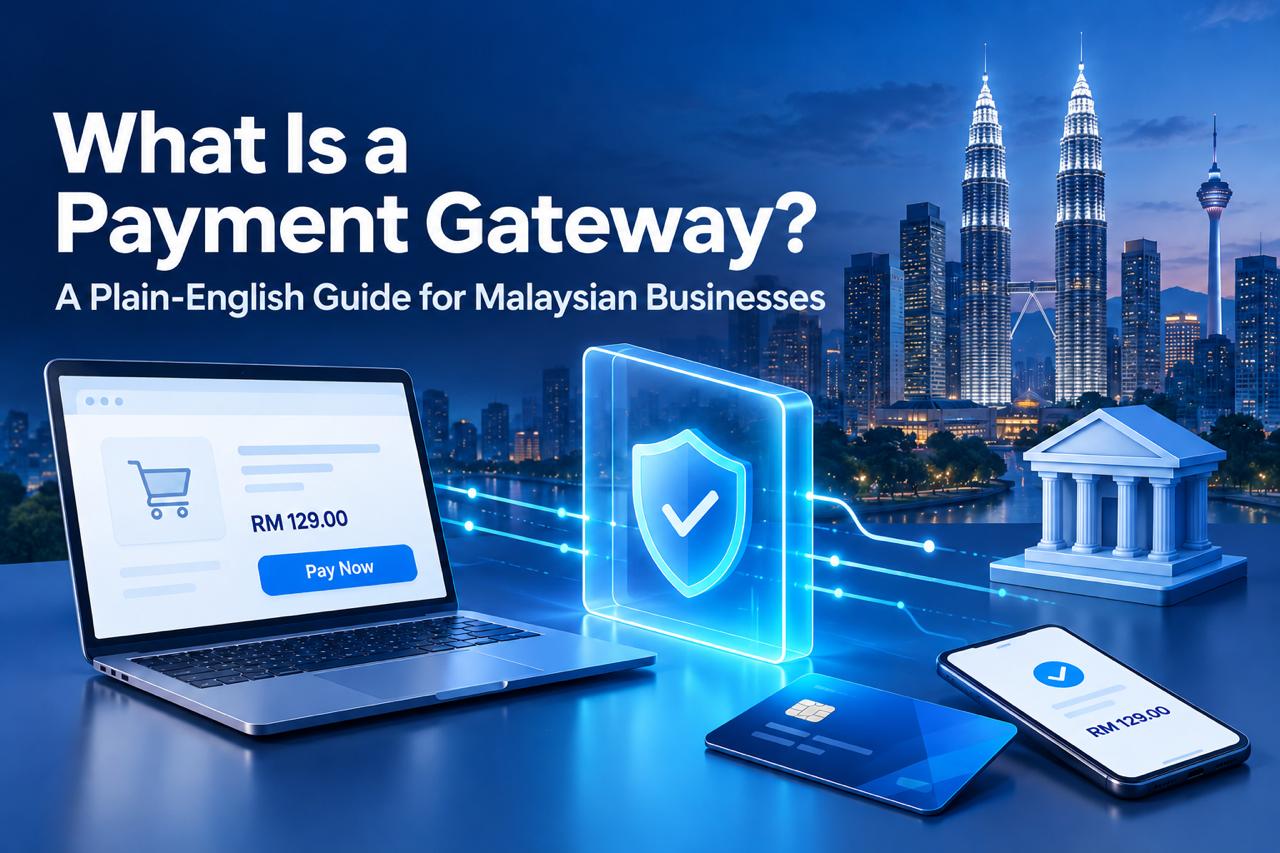
If you run a shop, a café, a clinic or an online store in Malaysia, you have probably been told you need a "payment gateway." The phrase sounds technical, but the idea behind it is simple. A payment gateway is the part of your payment setup that carries money from your customer's card, phone or bank account to your business account - safely, and in a matter of seconds.
This guide explains what a payment gateway actually does, how it fits together with the terminal on your counter and the POS system in your back office, and what it means for the way you get paid in Malaysia.
The one-line definition
A payment gateway is the digital bridge between your customer's payment method and your business's bank account.
When a customer taps a card, scans a DuitNow QR code or pays with an e-Wallet, the gateway is the system that checks whether the payment is genuine, asks the bank for approval, and confirms the result back to you. You never see the mechanics - you just see "Payment approved" and a receipt.
Think of it as the cashier till drawer in digital form: it receives the money, confirms it is real, and records that the sale happened.
What actually happens during one transaction
Take a customer buying a RM180 item with a credit card at your counter. Behind that single tap, five things happen:
- Capture. The terminal or online checkout collects the card details and the amount.
- Encryption. The gateway scrambles that information so it cannot be read while travelling.
- Authorisation. The gateway sends the request to the customer's bank, which checks the card is valid, has enough limit and is not blocked. This is where the familiar approval or decline comes from.
- Confirmation. The result comes back to your terminal or checkout page, usually in under three seconds. You print or display a receipt.
- Settlement. Later - often the next business day - the money moves from the banks into your business account, minus the agreed fee.
The customer experiences a tap. You experience a sale. The gateway is doing all the work in between.
Gateway, terminal, POS - what is the difference?
This is where most business owners get confused, because the words are often used as if they mean the same thing. They do not.
- The payment gateway is the software layer that processes the money. It is invisible.
- The terminal is the physical device on your counter - the machine the customer taps or inserts a card into. VirtuaPay's All-In-One Merchant Terminal is an example: it accepts cards, contactless taps and e-Wallet payments in one unit.
- The POS system is the wider platform that runs your sales - pricing, inventory, staff, reports, e-invoices. Payment is one part of it, not the whole thing.
A useful way to picture it: the POS is your shop's front desk, the terminal is the card machine sitting on it, and the gateway is the system that quietly moves the money through the banking network.
Some modern setups combine all three. Others let you plug your existing POS into a payment provider. What matters is that you know which piece you are buying, so you do not pay twice for something you already have.
The payment methods Malaysian customers actually use
Malaysia is one of the most cashless-friendly markets in the region, and your customers expect choice. A payment gateway worth having should handle, at minimum:
- Cards - Visa, Mastercard and UnionPay, both locally issued and from overseas visitors.
- FPX - direct online banking transfers, and still the default for a large share of Malaysian online shoppers
- DuitNow QR - the national QR standard, now a default expectation for many shoppers.
- e-Wallets - Touch 'n Go e-Wallet, GrabPay, Boost and ShopeePay are everyday payment tools here, not novelties.
- Foreign wallets - WeChat Pay and Alipay, which matter enormously if you serve tourists or international buyers.
- Buy Now Pay Later and instalments - increasingly important for higher-ticket purchases, from electronics to dental work.
If a provider cannot handle most of this list, you are quietly turning customers away at the counter. The sale does not fail loudly; the customer simply says "never mind" and leaves.
Settlement: when does the money reach you?
Settlement is the gap between the customer paying and your business actually receiving the funds. It is not instant in most cases, and the length of that gap affects your cash flow more than the fee does.
Ask any provider three questions before you sign:
- How many times a day do you settle, and at what cut-off time?
- Does settlement include weekends and public holidays?
- How do I see what has been settled and what is still pending?
A business doing RM20,000 a week on tight margins feels a one-day difference in settlement timing far more than it feels a 0.1% change in fees.
Security, in plain terms
You do not need to understand cryptography, but you should know what a serious payment provider does on your behalf:
- Encryption of card data in transit, so details cannot be intercepted.
- Tokenisation, which replaces real card numbers with harmless placeholder values in your systems - so a breach elsewhere does not expose your customers.
- PCI DSS compliance, the international standard for handling card data. Using a compliant provider transfers most of that burden away from you.
- Fraud monitoring, which flags unusual transaction patterns before they turn into chargebacks.
For a small business, this is the strongest argument for using an established payment partner rather than stitching something together in-house. The compliance work is heavy, and it is not your core business.
What you are actually paying for
Payment fees usually come as a small percentage of each transaction, sometimes plus a fixed amount per transaction, and sometimes a monthly or terminal rental fee. A few things to keep straight:
- The headline rate is not the whole cost. Compare total cost of ownership: rates, terminal fees, setup charges and settlement timing together.
- Different methods cost different amounts. Card transactions, QR payments and eWallet payments often carry different rates.
- Cheaper is not automatically better. A slightly higher rate with reliable uptime, fast settlement and real support usually beats a rock-bottom rate with a terminal that goes down on a Saturday.
A simple checklist before you choose
Before committing to any payment setup, confirm that it:
- Accepts every payment method your customers actually use.
- Works in-store and online from one provider, if you sell through both.
- Settles fast enough for your cash flow, including weekends.
- Gives you a real-time view of sales, so you are not reconciling blind.
- Offers instalment or BNPL options if you sell higher-ticket items.
- Has a support line you can reach when something goes wrong - because something eventually will.
- Can grow with you: more outlets, more staff, more channels, without starting over.
The bottom line
A payment gateway is not a piece of hardware and it is not a mystery. It is the system that turns a customer's intent to pay into money in your account, safely and quickly. Once you separate the gateway from the terminal and the POS, the whole picture becomes much easier to reason about.
For most Malaysian businesses, the right question is not "what is a payment gateway?" but "does my payment setup help me sell more, or quietly cost me sales?" Answer that honestly, and the choice of provider usually makes itself.
VirtuaPay helps Malaysian businesses accept payments in-store and online through one partner - cards, DuitNow, eWallets, instalments and more - so you can focus on running the business instead of chasing the money.
Topics
- payment terminal
- payment gateway
- payment link
Frequently Asked Questions
Ready to start accepting payments?
Talk to the VirtuaPay team about FPX, DuitNow, e-wallets and cards on one account.